The Accessible Reservation: How One Simple Question Can Improve the Dining Experience
Prepared for DineAbiliti | Restaurant owners, operators, managers, and diners
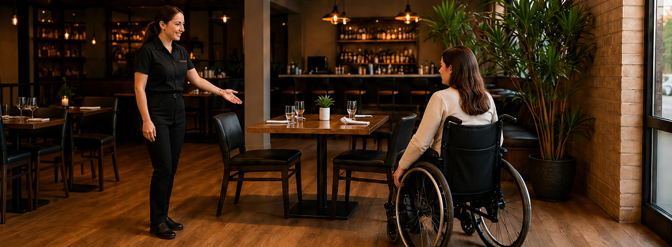
A guest arrives for a 7:00 p.m. reservation using a wheelchair. The restaurant has accessible tables, but the party has been assigned to a high-top.
The host starts looking for another table. Chairs are moved. Another reservation may need to be reassigned. The guest waits while the team tries to solve a problem that could have been addressed hours earlier.
For the diner, it is frustrating and uncomfortable. For the restaurant, it is an avoidable service problem during an already busy shift.
One simple reservation question can help prevent that situation:
That question gives guests an easy way to communicate what they need while giving restaurant staff something equally valuable: time to prepare.
For restaurant owners and operators, accessible restaurant reservations are not just about disability access. They can improve reservation management, staff readiness, guest satisfaction, repeat business, and the overall dining experience.
Why Restaurant Accessibility Starts With the Reservation
Accessibility is often associated with ramps, doorways, restrooms, and wheelchair-accessible seating. But the guest experience begins long before someone reaches the front door.
Many diners with disabilities spend additional time researching restaurants before visiting. In DineAbiliti’s national survey, 41.7% of surveyed diners with disabilities said they check general online reviews to research or confirm restaurant accessibility, while 38.3% said they call restaurants directly.
There is a reason for that extra planning. DineAbiliti found that 56% of surveyed diners with disabilities encounter accessibility challenges at least sometimes when dining out. Approximately 54% said they had decided not to dine at, or return to, a restaurant because of accessibility challenges.
For a restaurant, the reservation creates an opportunity to identify potential needs before they turn into service recovery.
What Should Restaurants Ask About Accessibility?
Restaurants do not necessarily need to ask guests whether they have a disability. Instead, ask what would help them enjoy the restaurant.
A simple optional question works well:
The wording is important. It does not require a guest to disclose a diagnosis. It does not assume what someone needs. And it recognizes that accessibility needs can vary significantly from one person to another.
Some disabilities are also not immediately visible. A guest may have hearing loss, low vision, chronic pain, limited stamina, sensory sensitivities, or another access need that staff would not recognize simply by looking at them.
The restaurant’s job is not to determine why someone needs an accommodation. It is to understand what would help.
That approach is consistent with ADA National Network guidance for food-service businesses, which recommends asking before providing assistance and then following the guest’s direction.
Common Accessibility Requests Restaurants May Receive
An accessibility request does not automatically mean an expensive modification or major operational change.
Guests may simply request:
- A standard-height table with room for a wheelchair or scooter
- A chair removed before arrival
- Seating near the restaurant entrance or accessible restroom
- A route to the table that avoids steps
- Additional floor space for a service animal
- A quieter table away from speakers, bars, or busy service areas
- A large-print or accessible digital menu
- Additional time or assistance while ordering
- A chair with arms or without arms
- Information about accessible parking, entrances, or restrooms
Many of these accommodations require little or no cost. What they require is advance communication.
The ADA National Network recommends accessible restaurant seating dispersed throughout dining areas and notes that chairs can be removed when needed to accommodate diners who remain in wheelchairs or scooters. It also recommends keeping clear paths through restaurant seating and service areas.
How Accessible Reservations Prevent Problems at Arrival
Consider two versions of the same reservation. A party of four arrives with one guest who uses a wheelchair.
In the first scenario, the reservation contains no accessibility information. The assigned table is a high-top. The host has to find another table, rearrange seating, and ask the party to wait. The restaurant eventually solves the problem, but the guest’s experience begins with inconvenience.
Now consider the same reservation with a note: “Wheelchair user. Standard-height table with chair removed, please.”
Before the guests arrive, the restaurant can assign an appropriate table, remove the chair, confirm the route is clear, and brief the host.
The physical restaurant has not changed. The preparation has.
One restaurant manager interviewed by DineAbiliti described reviewing reservation lists, identifying seating preferences, contacting guests when necessary, and confirming arrangements before arrival. The manager described the approach as “getting ahead of the curve.” That is exactly what an accessible reservation process can accomplish.
A Simple Five-Step Process for Restaurant Accessibility Requests
For owners and operators, accessibility should not depend on whether the right employee happens to be working that night. Create a simple process that every host and manager can follow:
- Ask: Include an optional accessibility or accommodation question when the reservation is made.
- Record: Place the request directly in the reservation notes. Do not rely on an employee to remember it.
- Confirm: If anything is unclear, contact the guest before the visit and ask what would work best.
- Prepare: Assign the appropriate table, remove a chair, identify an accessible route, prepare the requested menu format, or make another reasonable adjustment.
- Brief the team: Make sure the host, server, and manager know about the request before the guest arrives.
Better Preparation Is Easier for Staff Too
Accessibility is often discussed primarily from the customer’s point of view, but preparation also benefits restaurant employees.
When accessibility needs are known in advance, hosts are less likely to have to rearrange tables unexpectedly. Servers know what assistance may be requested. Managers have time to solve potential issues without making the guest wait.
- Fewer last-minute table changes
- Less confusion at the host stand
- Better communication between front-of-house employees
- Fewer avoidable service-recovery situations
- A more confident staff
- A better first impression for the guest
For a busy restaurant, accessibility and operational efficiency do not have to compete. Good preparation can support both.
Why Accessible Dining Can Be Good for Guest Loyalty and Business
Accessibility can influence where people choose to eat.
DineAbiliti found that 88% of surveyed diners with disabilities were more interested in visiting restaurants that highlighted strong accessibility features and a positive, welcoming attitude.
The influence goes beyond diners who identify as having disabilities. Among surveyed diners without a disclosed disability, 71% expressed greater interest in restaurants that demonstrated strong accessibility and a welcoming attitude.
That matters because dining decisions are often made for groups. A restaurant that works well for one person with an accessibility need may earn the business of that person’s family, friends, coworkers, or entire dining party.
DineAbiliti’s interviews with restaurant owners and managers also found operators connecting accessibility with customer satisfaction, reputation, inclusion, and revenue potential.
For small and midsize restaurants especially, accessible hospitality does not always require a major renovation. Sometimes the first improvement is simply asking a better question.
How to Add Accessibility to Your Restaurant Reservation Process
The accessibility question should appear anywhere guests can plan their visit.
For online reservations, include an optional accommodation field.
For phone reservations, train hosts to ask whether there is anything the restaurant can prepare to make the visit more comfortable or accessible.
For reservation confirmations, give guests a way to add or update an accommodation request before arriving.
On the restaurant website, publish accessibility information and provide a reliable phone number or email address for additional questions.
For walk-in guests, staff can still ask whether a seating option or other assistance would make the visit more comfortable.
The message should never feel like paperwork. It should feel like hospitality:
We want to know what will help you enjoy your visit.
Frequently Asked Questions About Accessible Restaurant Reservations
What should a restaurant ask about accessibility when taking a reservation?
Use an optional, needs-focused question such as: “Is there anything we can prepare to make your visit more comfortable or accessible?” This allows the guest to describe what they need without requiring unnecessary personal information.
Should restaurants ask customers if they have a disability?
What accessibility requests might restaurants receive?
How can restaurants prepare for guests with disabilities?
One Question Can Change the Experience
The reservation is one of the earliest opportunities a restaurant has to demonstrate great hospitality.
One optional question gives diners an easier way to communicate what they need and gives restaurant employees time to prepare.
For the guest, that can mean arriving with greater confidence. For the restaurant, it can mean fewer surprises and a smoother service experience.
Don’t wait until a guest reaches the host stand to discover what they need.
Ask early. Prepare before arrival. Welcome a guest to a restaurant that is ready for them.
DineAbiliti helps diners find firsthand information about restaurant accessibility while helping restaurant owners and operators better understand the experiences of guests with disabilities.
Restaurant teams can also use the DineAbiliti Restaurant Accessibility Checklist to evaluate mobility access, seating, menus, communication, service-animal practices, restrooms, and staff readiness.
Source Notes
- DineAbiliti National Restaurant Survey, commissioned by DineAbiliti and executed by Centiment, March 2025.
- ADA National Network, Food Service: Accommodating Diners with Disabilities.
- DineAbiliti qualitative interviews with small and midsize restaurant owners and managers, 2025.
- DineAbiliti Restaurant Accessibility Checklist and related materials
Related Posts
The Five-Minute Restaurant Accessibility Walkthrough: See Your Restaurant Through a Guest’s Eyes
Is Your Digital Menu Actually Accessible? A Practical Guide for Restaurants